
What initially appeared to be an ordinary storage facility was uncovered as a key link in a counterfeit lubricant manufacturing operation in the UAE.
From the outside, there was little to suggest what was happening behind the doors of an unmarked warehouse.
Inside, however, authorities uncovered the pieces of what appeared to be a much larger counterfeit manufacturing operation — an operation that had not yet reached its final stage.
The operation began with intelligence identifying the premises as a suspected storage point for materials used in the production of counterfeit lubricant products. Rather than moving immediately to enforcement, the ATB team maintained continuous surveillance of the location following the submission of a formal complaint to the authorities.
The objective was simple: watch, verify, and wait for the right moment to act.
Throughout the surveillance period, the team monitored the premises to ensure that the suspected materials remained in place and were not dispersed before enforcement action could be carried out.
On the evening of July 30, 2026, authorities entered the warehouse and found relatively few finished products. But what initially appeared to be a limited presence quickly revealed something far more significant.
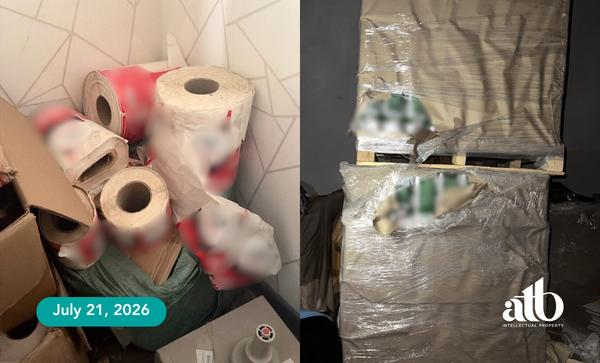
Across the premises were large quantities of empty cartons, containers, cans, oil gallons, caps, stickers, labels, adhesive materials, and other packaging components. Molds and blocks used in the manufacture of oil gallons were also discovered.
Individually, these items may have appeared to be nothing more than packaging materials.
Together, they told a very different story.
The sheer volume and variety of materials indicated that the warehouse was not simply being used for storage. It appeared to be supporting a production process designed to assemble, package, and ultimately distribute counterfeit lubricant products on a significant scale.
By the end of the inspection, authorities had seized nearly 70,000 branded materials and components from the premises. The seizure included thousands of empty containers and cartons, tens of thousands of stickers and caps, adhesive materials, and several ready-product oil gallons.
Yet the most important discovery was not simply the quantity seized — it was when the operation was intercepted.
The majority of the materials had not yet entered the filling and production stage. The counterfeit products were still in pieces, waiting to be transformed into finished goods.
That gave the enforcement action a critical advantage.
By intervening before production was completed, authorities prevented a substantial quantity of potential counterfeit products from moving further through the supply chain and reaching the market. The materials themselves also preserved valuable evidence of the intended manufacturing activity.
The scale of the operation became even more apparent once the raid was complete. It took six trucks and ten laborers to transfer the seized materials to a logistics facility for secure storage pending the conclusion of the legal proceedings.
What began as a piece of confidential intelligence had ultimately led the enforcement team to a warehouse containing the building blocks of a significant counterfeit production operation.
And in this case, the greatest success was not simply taking counterfeit goods off the market.
It was stopping them before they were ever finished.
This operation demonstrates the importance of intelligence-led enforcement and early intervention in disrupting counterfeit supply chains. Through sustained surveillance and close cooperation with enforcement authorities, ATB Intellectual Property continues to help identify and address counterfeit activities before they progress further into the market.